FAQ
Frequently Asked Questions
What Areas Can Be Treated With Electrolysis?
Electrolysis is safe and effective for all types of skin and hair. It may be performed on almost any part of the body, except for inside the nose and ear canal.
In the state of Oregon, a doctor’s written consent is required for the following conditions:
Hair growing out of a mole
Eyelashes – ingrown, as well as those that curve downward and affect the cornea
Situations involving a pacemaker, neuromodulator, or other implantable electronic devices
Does Electrolysis Hurt?
Most people are very pleasantly surprised to find that the discomfort is not as bad as they might’ve thought.
Sensitivity varies between individuals, and can be affected by things like stress, lack of sleep, and caffeine. Sensitivity can also vary in different areas of the body, and even from one treatment to the next.
Topical anesthetics – both over-the-counter and prescription – can be used to maximize your comfort. Many people find that listening to music, audiobooks, and podcasts is a great distraction, and helps them relax.
Is Electrolysis a Licensed Profession?
In Oregon, all practicing electrologists must be properly trained and licensed, and follow Standards of Practice (e.g., client care, infection control procedures, etc.) as required by the state’s Health Licensing Office. They must also fulfill annual Continuing Education requirements in order to maintain their status. Not all states require licensing (such as Washington), so it might be worth asking about training and examinations.
Practitioners also have the option of membership in professional organizations, such as the American Electrology Association (AEA) and the Oregon Association of Licensed Electrologists (OALE). The AEA has also developed its own infection control standards, based on recommendations from OSHA and the CDC.
What Should I Do Between Treatments?
This will depend on personal preference, as well as which area is being treated. Someone doing hair removal from the underarms may be less worried about how things look than someone who is working on the face.
If you normally pluck or wax, it’s best to stop if you can, because these methods are irritating to the skin and can even cause increased hair growth. They will also affect the overall length of treatment, because once you remove the hair from the follicle, you’ll have to wait until it produces another one before it can be treated. With that said, there can be situations in which a person feels there’s no way to avoid plucking (e.g., before an important event), and that’s understandable, so don’t be too hard on yourself if that turns out to be the case. The total amount of time you spend in the electrolysis chair will still be the same, it’ll just be spread out over a longer period of time.
The simplest thing is to just leave the hair alone, but if that doesn’t work well for you, another option is to either shave or clip. These methods won’t interfere with the growth cycle, and the follicle can be be treated at the next session. With shaving, 1-2 days’ worth of growth is usually enough; with clipping, it’s almost impossible to cut it too short.
What Can Be Done About an Ingrown Hair?
Anyone who has ever suffered with one or more of these knows that they can be difficult to deal with.
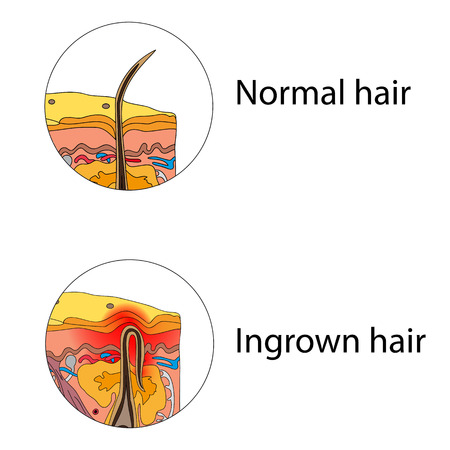
An ingrown hair is one that gets trapped under the skin, usually due to some sort of irritation. The hair is unable to get through to the surface, so it begins to grow in any direction that will allow it, often sideways and parallel to the surface of the skin. This can lead to more irritation, which will then causes the same problems for other newly emerging hairs in the vicinity, and can easily turn into a vicious cycle.
Whether or not you choose electrolysis as a way to deal with these hairs, there is something else you can do to improve the situation. The hairs are blocked by skin, and the only way to get to them is to remove the blockage. This can be accomplished either all at once (digging the hair out) or gradually over time, through exfoliation.
Digging a hair out – carefully – can be successful if it’s right under the surface. But if it’s too far down, you can do damage, and end up with a permanent little scar.
Exfoliation helps to speed up the process of surface skin cell turnover (shedding the old and replacing with new), gradually bringing the hair closer to the surface. It can be done either mechanically (loofahs, scrubs) or chemically (gels, liquids). An excellent product for ingrowns is “TendSkin” (It will probably dry out the skin, so be prepared.)
What About Laser Hair Removal?
Laser hair removal has been classified by the FDA as a method of Permanent Hair Reduction (not “Removal”). The FDA’s designation of Permanent Hair Removal is reserved exclusively for electrolysis.
If done properly and with the right type of machine, laser can help reduce the original amount of hair growth. Sometimes, people with a substantial amount of growth will complete a course of laser, then follow up with electrolysis to get whatever comes back.
Note: in some cases, laser has actually caused hair growth to increase. If you’re looking into laser, be sure to ask the practitioner about any and all potential unwanted side effects.
Laser is not effective for blonde, white, grey, or red hair.